
PEMF Mats: The Complete 2026 Buyer’s Guide
Quick answer
A PEMF mat exposes your whole body to a programmable pulsed electromagnetic field in 8 to 40 minute sessions while you lie on it. The technology has been FDA-cleared for bone healing since 1979, but consumer mats run at lower intensities than clinical systems and results vary by device, protocol and person. The specs that matter are frequency range, intensity in gauss, waveform, program variety and FDA clearance status; daily 15 to 30 minute use is considered safe for healthy adults, but not with a pacemaker.
PEMF mats promise whole-body frequency wellness in 20 minutes a day. The market sprawls from $300 imports to $6,000 premium systems — and the spec sheets rarely make it easy to compare them honestly. This guide cuts through the marketing to help you understand what actually matters when choosing a PEMF mat.
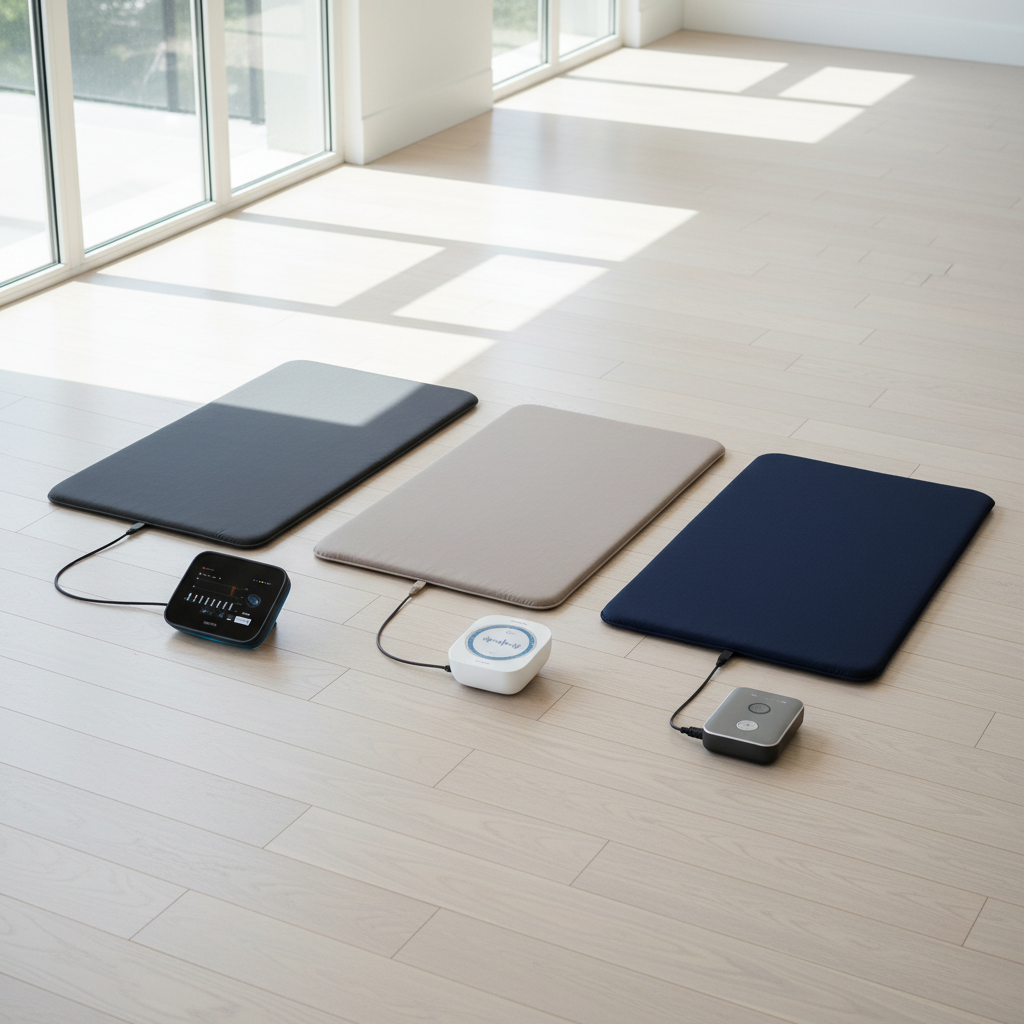
Pulsed electromagnetic field (PEMF) mats are the full-body version of a technology that’s been FDA-cleared for bone healing since 1979. Unlike clip-on wearables or handheld applicators, a mat exposes your whole body to a programmable electromagnetic field, typically in 8-40 minute sessions while you lie on it. The appeal is obvious: no cables, no electrodes, no targeting specific areas. You lie down, and the field does the rest.
The challenge is that PEMF mats vary enormously in quality, intensity, frequency range, waveform design, and price. A $400 mat and a $5,500 mat can both be called “PEMF mats” while delivering dramatically different experiences. This article explains what to look for, how major brands compare, and who each type of mat is actually right for.
In this guide
- What is a PEMF mat?
- How PEMF mats work
- Reported benefits and evidence
- Specs that matter (and specs that don’t)
- PEMF-only vs. multi-therapy mats
- Major PEMF mat brands compared
- Price tiers: what you get at each level
- How to use a PEMF mat
- Safety and contraindications
- Who is a PEMF mat right for?
- Frequently asked questions
What is a PEMF mat?
A PEMF mat is a full-body electromagnetic field delivery system, typically the size of a yoga mat or slightly larger. Inside the mat are copper or coil-based conductors arranged to produce a pulsed magnetic field when electrical current flows through them. A separate control unit lets you adjust frequency, intensity, program, and session duration.
You use it by lying directly on the mat — usually fully clothed — for a session lasting anywhere from 8 to 60 minutes depending on the program. The electromagnetic field passes through your body regardless of clothing, and the field strength diminishes with distance from the coils.
Unlike handheld or wearable PEMF devices that target specific areas, mats are designed for whole-body exposure. That’s both their main advantage (broad coverage, no positioning required) and their main limitation (less focused intensity than a targeted applicator can deliver to a specific body part). For a full explainer of PEMF technology itself, see our guide to pulsed electromagnetic field therapy.
How PEMF mats work
PEMF mats operate on the same physical principles as clinical PEMF devices. Here’s what actually happens when you turn one on:
- The control unit generates a pulsed electrical signal — a precisely timed waveform at a set frequency (usually 1-30 Hz for wellness mats).
- The signal flows through coils embedded in the mat, which convert the electrical pulses into a corresponding magnetic field that extends a few inches above the mat surface.
- The magnetic field penetrates your body, inducing tiny electrical currents in tissues — similar in magnitude to the currents your cells produce naturally during normal biological function.
- These induced currents interact with cell membranes, potentially supporting cellular processes like ion transport, ATP production, and microcirculation.
The specific therapeutic effects depend on three engineering variables: frequency (how fast the field pulses), intensity (how strong the field is, measured in Gauss or Tesla), and waveform (the shape of the pulse — sine, square, sawtooth, or proprietary combinations). Different combinations are theorized to produce different cellular responses.
Reported benefits and evidence
The research evidence for PEMF is strongest in clinical applications using medical-device-grade systems. Consumer home mats use similar principles at lower intensities, and results at home vary by device, protocol, and individual.
Areas with clinical research support
- Bone healing — FDA-cleared since 1979 for non-union fractures; clinical devices differ from consumer mats
- Microcirculation support — BEMER has published research on capillary blood flow
- Post-surgical recovery — reduced swelling and improved healing in some studies
- Chronic pain management — multiple systematic reviews suggest modest benefits
- Musculoskeletal conditions — especially osteoarthritis and fibromyalgia
Commonly reported user experiences from home PEMF mat use include improved sleep quality, reduced exercise soreness, general relaxation, and sense of increased energy. These subjective reports are valuable but harder to isolate from placebo effects, lifestyle factors, and the inherent benefit of lying still for 20 minutes.
For people with specific medical conditions, clinical PEMF systems administered by a practitioner offer stronger evidence than home mats. Home PEMF mats are best positioned as general wellness support rather than medical treatment.
Specs that matter (and specs that don’t)
Marketing for PEMF mats is dense with specs. Some genuinely matter; some are marketing theater. Here’s how to tell them apart.
Frequency range (important)
Most wellness-oriented PEMF mats operate below 30 Hz, the range thought to correspond to naturally occurring biological rhythms. A broader frequency range gives more programming flexibility — OMI’s mat offers 1-99 Hz, while BEMER’s system uses only 10 Hz and 33 Hz. More frequencies isn’t automatically better, but locked-in proprietary frequencies limit your experimentation.
Intensity in Gauss (important but contextual)
PEMF mats generally fall into “low-intensity” territory — typically 0.1 to 5 Gauss — which is classified within International Commission on Non-Ionizing Radiation Protection (ICNIRP) safe ranges. Higher intensity isn’t inherently better for wellness applications. Clinical PEMF systems for bone healing operate at much higher intensities (50-300+ Gauss) but are not designed for home use.
Waveform (important)
The shape of the electrical pulse matters because different waveforms induce different biological responses. Sine waves are smooth and continuous. Square waves create sharper stimulation. Sawtooth waves ramp up then drop off. Advanced mats offer multiple waveforms; budget mats often use a single fixed waveform. Research on specific waveforms’ effectiveness is limited and often manufacturer-funded.
Program variety (moderately important)
Pre-set programs guide session duration, frequency, and intensity combinations. For most users, 6-12 well-designed programs are plenty. 300+ programs often indicate marketing overreach — most users settle into 2-3 favorites.
FDA clearance status (important for context)
FDA-cleared devices (like BEMER) meet specific quality and safety standards and are often eligible for HSA/FSA reimbursement. “FDA registered” is not the same as “FDA cleared” — the former just means the manufacturer has registered with the FDA. Many excellent consumer mats are not FDA-cleared, but the clearance does carry weight.
What matters less than marketing suggests
- “Proprietary signal technology” — often unverifiable marketing language
- Crystal or gemstone layers — no demonstrated PEMF benefit
- “Negative ion technology” — marketing layer with thin evidence
- Celebrity endorsements — tells you nothing about actual performance
- Total program count over 50 — diminishing returns past this point
PEMF-only vs. multi-therapy mats
A significant market split has emerged: traditional PEMF-only mats versus multi-therapy mats that layer PEMF with far infrared heat, red light, negative ions, and gemstone warming.
Multi-therapy mats tend to feel more impressive during a session — the heat, the warmth, the visible red lights — which drives user satisfaction. Whether the added therapies offer additional PEMF benefit or just layered placebo effect is debated. For users who specifically want PEMF, PEMF-only mats tend to have better PEMF engineering. For users who want a daily relaxation ritual with PEMF included, multi-therapy mats deliver a more enjoyable experience.
Major PEMF mat brands compared
Here’s an honest look at the brands buyers ask about most. We’re not ranking them — the “best” mat depends on your priorities.
BEMER
One of the most heavily marketed and studied PEMF systems, though much of that research is industry-affiliated and independent results on circulation have been mixed. BEMER holds an FDA Class II clearance for muscle stimulation and temporary improvement of local blood circulation. Two frequency bands (around 10 Hz and 30 Hz), 10 intensity settings at a low intensity of roughly 0.035-0.35 Gauss (max ~35 µT), proprietary signal. Sold through a multi-level marketing distributor network, which contributes to its premium price (roughly $4,590 for the Basic-Set Evo to $5,490 for the Classic Evo).
Strengths: large published research base, medical-grade quality control, microcirculation focus, FDA Class II clearance. Weaknesses: very expensive, low field intensity, limited frequency flexibility, MLM pricing structure, and much of its supporting research is industry-affiliated — independent evidence on circulation is mixed. Read our full BEMER review.
HigherDOSE Infrared PEMF Mat
A multi-therapy mat combining PEMF, far infrared heat, negative ions, and a crystal layer. 4 PEMF frequencies, adjustable heat, yoga-mat form factor. Popular on social media, premium positioning ($1,295 for full-size, $699 for Go mat).
Strengths: luxurious sensory experience, good build quality, 120-day return policy, excellent marketing ecosystem. Weaknesses: limited PEMF frequency range, no grounding layer, some of the “therapy” is marketing.
OMI (Oxford Medical Instruments)
A budget-friendly PEMF-only option with the widest frequency flexibility in its price range — 1-99 Hz, typically at 2.2 Gauss. Full-body mat, mini mat, wearable wrap, and ring options. Direct-to-consumer pricing for the full-body mat runs roughly $1,250-$1,350.
Strengths: exceptional frequency flexibility, reasonable price, good warranty (3 years), customization potential. Weaknesses: less slick user experience, fewer “quality of life” features, less marketing polish than competitors.
iMRS Prime
A PEMF-only system from Swiss Bionic Solutions, respected among serious PEMF users. Its whole-body mat runs a 0.5-15 Hz range using a triple-sawtooth waveform (a square waveform is used on the local applicator). Systems typically $3,000-$5,000+ depending on configuration.
Strengths: multiple waveforms, well-engineered, practitioner endorsements, research-backed design. Weaknesses: price, distributor-sold with variable pricing, complex configuration choices.
HealthyLine
A multi-therapy mat line featuring PEMF combined with far infrared, negative ions, and gemstones. Many model variations; the Platinum series targets users wanting full customization (1-30 Hz, sine and square waveforms, photon LEDs). Price range roughly $500-$2,500.
Strengths: wide product range, good value in the Platinum tier, gemstone warming feels luxurious. Weaknesses: PEMF is one of many features rather than the focus, marketing claims can overreach.
Bon Charge Infrared PEMF Mat
A multi-therapy mat positioned against HigherDOSE with a similar feature set — PEMF + far infrared + ions + crystals. Its full-size PEMF Mat Max is typically priced around $1,295, comparable to HigherDOSE.
Strengths: good build, trusted wellness brand, smaller mat options (Demi, Mini) for chairs and travel. Weaknesses: PEMF specs are basic, priced similarly to HigherDOSE rather than undercutting it.
QRS (Quantron Resonance System)
A German-made PEMF-only system with a broader frequency range than BEMER (3-1000 Hz through program cycles). Respected among practitioners. Price typically $3,000-$4,500.
Strengths: German engineering, wide frequency range, practitioner approval. Weaknesses: distributor-dependent availability, limited direct-to-consumer support.
Price tiers: what you get at each level
Under $500 — Entry Level
Basic PEMF mats, often imported. Limited frequency options, single waveform, minimal warranty. Fine for curious experimentation; not ideal for serious use.
Examples: BioBalance, budget Amazon imports, entry PEMF pads
$500-$1,500 — Mid Range
The sweet spot for most buyers. OMI, HigherDOSE Go, Bon Charge, HealthyLine Classic. Real programmability, decent warranties, genuine PEMF engineering.
Examples: HigherDOSE Go ($699), HealthyLine Classic, OMI Full Body (~$1,250)
$1,500-$3,000 — Premium
Multi-therapy premium mats or mid-tier PEMF-only systems. HigherDOSE full size, HealthyLine Platinum, entry iMRS configurations. Better customization, premium materials, refined UX.
Examples: HigherDOSE Infrared ($1,295), HealthyLine Platinum (~$2,200)
$3,000-$6,000+ — Professional Grade
BEMER, QRS, iMRS Prime complete systems. FDA clearance, clinical research, professional positioning. For serious enthusiasts, practitioners, or households prioritizing wellness investment.
Examples: BEMER Evo Classic ($5,490), iMRS Prime Hybrid ($5,000+)
How to use a PEMF mat
The basic protocol is similar across mats, with brand-specific tweaks. Standard practice:
- Start with short sessions. 8-15 minutes, once daily, for the first week. Some users experience mild fatigue or “too much, too fast” sensations with aggressive initial use.
- Build to 20-30 minutes once or twice daily. This is the standard maintenance protocol for most consumer mats. Clinical-grade systems may recommend different schedules.
- Use low-frequency programs before bed. Lower frequencies (under 10 Hz) tend to be more relaxing and sleep-supportive.
- Use higher-frequency programs during the day. Higher frequencies (15-30 Hz) tend to feel more energizing.
- Stay hydrated. Drink water before and after sessions; PEMF can increase cellular activity and circulation.
- Keep electronics away. Phones, laptops, smartwatches, and hearing aids should be at least 6 feet from active mats, especially higher-intensity systems.
Consistency matters more than session length. 15 minutes daily beats 60 minutes once a week. Most users report noticeable effects (sleep, energy, recovery) within 2-4 weeks of regular use.
Safety and contraindications
PEMF mats are among the more cautious frequency wellness devices in terms of contraindications — not because they’re dangerous for most people, but because the electromagnetic field can interact with implanted electronic devices and specific medical conditions.
Do NOT use a PEMF mat if you have:
- A pacemaker, implanted defibrillator, cochlear implant, or neurostimulator
- An insulin pump or intrathecal drug delivery pump
- Active internal bleeding or severe bleeding disorders
- Had an organ transplant (due to immunosuppressant interactions)
- Ferromagnetic implants in the area of exposure
Consult a physician before use if you:
- Are pregnant (safety not established; most manufacturers advise against use)
- Have epilepsy or a history of seizures
- Are under 18 (especially during growth phases)
- Have active cancer or undiagnosed growths
- Take prescription medications, especially blood thinners
For a deeper look at PEMF safety across device categories, see our complete safety guide.
Who is a PEMF mat right for?
✓ Good fit for you if…
- You value daily wellness practices and routines
- You want whole-body exposure without targeting
- You appreciate FDA-cleared or research-backed products
- You have space for a dedicated mat
- You deal with general aches, poor sleep, or recovery needs
- You can commit to 20+ minutes daily for 6+ weeks
✗ Probably not for you if…
- You have any absolute contraindications
- You want immediate, dramatic symptom relief
- You’re looking for medical treatment, not wellness support
- You travel constantly (mats are bulky)
- You’re budget-constrained — consider wearables instead
- You’re seeking targeted pain relief — consider a handheld unit
If you’re unsure whether a PEMF mat is the right category, our device selection guide walks through the broader decision between mats, wearables, and handhelds.
Frequently asked questions
How long does a PEMF mat last?
Most quality PEMF mats are designed for 8-10+ years of use. The control unit is typically the first component to fail. Reputable brands offer warranties ranging from 1-5 years on the mat and 1-3 years on the control unit.
Do I need to be naked or can I use it through clothing?
Clothing does not block PEMF. You can use a mat fully clothed. Many multi-therapy mats with infrared heat work better with lighter clothing so heat transfers more easily, but the PEMF component passes through anything non-metallic.
Can multiple people use the same mat?
Yes, though not simultaneously. Sharing is fine; just run separate sessions. Contraindications apply per user — make sure each user has been cleared.
Can I use a PEMF mat every day?
Yes. Daily use at appropriate durations (15-30 minutes) is standard and considered safe for healthy adults. Some users run morning and evening sessions. Avoid dramatically longer sessions (60+ minutes multiple times daily) unless under professional guidance.
How long before I notice effects?
Most users report subjective improvements in sleep or relaxation within 1-2 weeks. Effects on soreness, recovery, or energy may take 3-4 weeks of consistent daily use. Give any new PEMF mat at least 30 days before evaluating.
Is a $1,000 mat really better than a $400 mat?
Usually, but not always. A well-made $1,000 mat typically offers better engineering, wider frequency range, more durable construction, and better customer support. That said, budget mats can work well for casual curious use. The jump from $1,000 to $5,000 is less about PEMF quality and more about FDA clearance, clinical research, and premium positioning.
Should I get a wearable PEMF device instead?
Wearables (like the Healy or NeoRhythm) offer portability and targeted application but typically at lower intensity than mats. If you want daily whole-body exposure at home, a mat is superior. If you want portability, targeted pain relief, or variety of programs beyond PEMF, a wearable may serve you better. See our best frequency devices guide for comparisons.
Do PEMF mats really work?
The evidence for PEMF is strongest in clinical applications using medical-device-grade systems, while consumer home mats use similar principles at lower intensities and results vary by device, protocol, and individual. Commonly reported experiences from home use include improved sleep quality, reduced exercise soreness, general relaxation, and a sense of increased energy. These subjective reports are valuable but harder to isolate from placebo effects, lifestyle factors, and the inherent benefit of lying still for 20 minutes, so home PEMF mats are best viewed as general wellness support rather than medical treatment.
Are PEMF mats safe?
PEMF mats generally fall into low-intensity territory classified within ICNIRP safe ranges, and daily use at typical durations of 15–30 minutes is considered safe for healthy adults. However, you should not use a PEMF mat if you have a pacemaker, implanted defibrillator, cochlear implant, neurostimulator, insulin pump, active internal bleeding, an organ transplant, or ferromagnetic implants in the area of exposure. Consult a physician first if you are pregnant, have epilepsy or a history of seizures, are under 18, have active cancer or undiagnosed growths, or take medications such as blood thinners.
What should I look for in a PEMF mat?
The specs that genuinely matter are frequency range, intensity in Gauss, waveform, program variety, and FDA clearance status, since these determine how flexible and well-engineered a mat actually is. Higher intensity and huge program counts are not automatically better, and most users settle into just two or three favorite programs. Treat marketing extras like crystal or gemstone layers, negative-ion technology, proprietary signal claims, and celebrity endorsements with skepticism, as they tell you little about real PEMF performance.
Keep exploring
References
- Caliogna, L., et al. (2021). Pulsed electromagnetic fields in bone healing: molecular pathways and clinical applications. International Journal of Molecular Sciences, 22(14), 7403. PMC8303968
- Cadossi, R., Massari, L., Racine-Avila, J., & Aaron, R. K. (2020). Pulsed electromagnetic field stimulation of bone healing and joint preservation. JAAOS Global Research & Reviews, 4(5), e19.00155. PMC7434032
- Klopp, R. C., et al. Capillary blood flow increase via BEMER signal — published microcirculation studies.
- FDA 510(k) Premarket Notification database. Searchable at accessdata.fda.gov
- International Commission on Non-Ionizing Radiation Protection (ICNIRP). (2020). Guidelines for limiting exposure to electromagnetic fields (100 kHz to 300 GHz).
Disclaimer: This article is provided for educational and informational purposes only and does not constitute medical advice. PEMF mats are not intended to diagnose, treat, cure, or prevent any disease. Always consult a qualified healthcare professional before beginning any new wellness practice, especially if you have an existing medical condition, implanted electronic device, or are pregnant. Frequency Tech is reader-supported; see our Affiliate Disclosure for details on our relationships with device manufacturers. Pricing and feature information is accurate as of publication and may have changed.
PEMF silo: keep exploring
This buyer’s guide sits at the center of our PEMF coverage: