
What Are Binaural Beats? The Science Behind Sound Frequency Wellness
Quick answer
Binaural beats are an auditory illusion: play two slightly different tones into each ear and the brain perceives a third pulsing tone at the difference frequency. The idea that this nudges brainwaves toward the beat frequency has been confirmed in some studies and not in others. Anxiety reduction has the strongest support, with a 2024 systematic review finding binaural beats outperformed control conditions in most studies. They cost nothing beyond headphones and carry virtually no physical risk, which makes them the easiest frequency technology to try.
Put on headphones and play a steady 200 Hz tone into your left ear and a 210 Hz tone into your right. What you hear is neither of them. Your brain manufactures a third tone that pulses ten times a second, and that pulse exists nowhere in the air between the headphones and your eardrums. It is called a binaural beat, and researchers have spent five decades arguing about whether the brain that invents it is changed by it.
Binaural beats are also the cheapest thing in frequency wellness by a wide margin. No device, no subscription, nothing but a pair of stereo headphones you probably already own. Whether that free experiment is worth twenty minutes of your evening comes down to evidence that is more interesting, and a good deal more mixed, than either the enthusiasts or the debunkers tend to admit.
Table of Contents
- What Are Binaural Beats?
- How Binaural Beats Work in the Brain
- The Five Brainwave Ranges and What They Do
- What the Research Says
- How to Use Binaural Beats
- Best Apps and Tools
- Binaural Beats vs. Other Frequency Technologies
- Limitations and Honest Caveats
- Key Takeaways
- Frequently Asked Questions
What Are Binaural Beats?
A binaural beat is an auditory illusion. Play two tones of slightly different frequency at the same time, one in each ear through stereo headphones, and the brain perceives a third tone oscillating at the difference between them.
If your left ear gets 200 Hz and your right ear gets 210 Hz, the perceived beat sits at 10 Hz. You don’t hear it as a separate sound sitting alongside the others. It arrives as a gentle pulsing or wavering inside the combined tone, closer to a texture than a note.
Prussian physicist Heinrich Wilhelm Dove described the effect in 1839, after which it sat quietly in the hearing-research literature for more than a century. Biophysicist Gerald Oster’s 1973 article in Scientific American is what pulled it back out, largely by suggesting the beat could be used as a probe of neurological function rather than treated as a party trick of the auditory system.
The wellness interest rests on a coincidence of numbers. Perceived beat frequencies usually land between 1 and 30 Hz, which happens to be the range of the brain’s own electrical oscillations, or brainwaves. If you can perceive a 10 Hz pulse, the reasoning goes, perhaps the brain’s electrical activity will fall into step with it. That proposed effect is called brainwave entrainment, and almost every real argument in this field is about whether it happens.
How Binaural Beats Work in the Brain
The beat is assembled well inside the head, not in the ears.
Each ear passes its own tone up to the brainstem separately. The two signals first meet at the medial superior olivary nucleus (MSO), the earliest point in the auditory system where input from both ears is compared. The MSO reads the frequency difference between them and produces the beat you perceive. From there the combined signal travels on through the inferior colliculus and out into wider regions of the brain.
The entrainment hypothesis says that when the brain processes this rhythm, its own oscillations begin to lock onto the beat frequency, a response known as the frequency-following response (FFR). Play a 10 Hz beat, which sits in the alpha range, and the prediction is that activity shifts toward the alpha pattern associated with relaxed, calm alertness.
EEG recordings do show measurable changes under some conditions. A 2023 systematic review published in PLOS ONE examined 14 studies on brainwave entrainment and found entrainment in the theta, alpha and gamma bands in some of them. The overall picture was inconsistent. Some studies found the effect, others looked for it and did not.
A 2025 parametric study published in Scientific Reports confirmed that binaural beats do entrain brain activity at their own frequencies in the beta and gamma bands, which is genuine physiological evidence that something is happening. The same study also showed how fragile the effect is. It depended on the beat frequency, the carrier tone, when the beat started, and whether background noise was masking it.
So the brain responds. It just doesn’t respond the way the marketing implies, where you play 10 Hz and collect alpha waves. Context, individual variation and listening conditions all move the result.
The Five Brainwave Ranges and What They Do
Different beat frequencies map onto different brainwave states, which is how people decide what to put on.
| Brainwave | Frequency | Associated State | Use For |
|---|---|---|---|
| Delta | 1–4 Hz | Deep sleep, unconscious repair | Sleep support, deep rest |
| Theta | 4–8 Hz | Deep meditation, creativity, daydreaming | Meditation, creative flow, relaxation |
| Alpha | 8–14 Hz | Calm alertness, relaxed focus | Stress reduction, light meditation, unwinding |
| Beta | 14–30 Hz | Active thinking, concentration, problem-solving | Focus, studying, productivity |
| Gamma | 30–50 Hz | Peak awareness, information processing, memory | High-level cognition, memory consolidation |
Practical guidance: To relax or meditate, pick theta or alpha (4–14 Hz). To focus or study, pick beta (14–30 Hz). For sleep support, pick delta (1–4 Hz). Start with alpha. It is the most studied range and the one most people find pleasant on a first listen.
What the Research Says
The research base is moderate and growing, and noticeably thinner than what exists for PEMF or TENS.
Anxiety and stress reduction
This is the strongest area of binaural beats research. A 2024 systematic review published in Applied Sciences examined 12 studies on binaural beats for anxiety and depression, and found they generally did better than control conditions such as no music or noise-cancelling headphones alone. Ten of the twelve studies looked at anxiety in patients facing medical procedures, and the results there were consistently positive.
A separate 2024 systematic review of RCTs looked specifically at non-clinical stress management, searching six major databases. It found support for binaural beats in pain, cognition and anxiety across the existing literature.
Memory and attention
A 2023 meta-analysis published in Psychological Research pooled studies on memory and attention. Results came out encouraging but uneven: positive effects in some cognitive domains, nothing much in others. The authors asked for more work with consistent experimental parameters before anyone draws firm conclusions.
A 2025 study published in Scientific Reports confirmed measurable entrainment at the target beta and gamma frequencies, with the clearest effect for gamma beats that were not masked by white noise. The attention benefits were another matter. They were modest, depended heavily on the exact parameters, and on average the beats did not slow the decline in sustained attention across the task.
Sleep
The sleep literature is smaller but building. Theta beats have been shown to alter EEG activity in people with insomnia, and low-frequency beats may shorten the time it takes to fall asleep during daytime naps. One study found that alpha entrainment before sleep helped with pain perception and sleep quality in fibromyalgia patients. Sample sizes have been small throughout, and the researchers themselves keep asking for longer trials with more people in them.
Brainwave entrainment itself
The fundamental question, whether binaural beats entrain brainwaves at all, has produced contradictory answers. The 2023 PLOS ONE systematic review found that five of fourteen studies supported the entrainment hypothesis, eight found no effect, and one reported mixed results. Entrainment showed up for theta, alpha and gamma, but not for beta. The authors pointed out that study designs varied so widely that comparing them directly is close to impossible.
The honest picture
Calling binaural beats a proven treatment would be wrong, because the evidence is nowhere near consistent enough to carry that claim. Calling them pseudoscience would also be wrong, because controlled studies have recorded real changes in brain activity. What sits between those two positions is a promising effect, clearest for anxiety and relaxation, still waiting on larger and better standardised trials before anyone can make a clinical recommendation with a straight face.
→ Deep dive: The Science Behind Frequency Technology
How to Use Binaural Beats
Requirements
Stereo headphones are essential. Each ear has to receive its own frequency. Speakers blend the two tones together in the air before they reach you, which destroys the beat completely. Over-ear headphones tend to work best because they seal out room noise and deliver clean audio, though in-ear buds are fine as long as they stay comfortable for half an hour.
Your first session
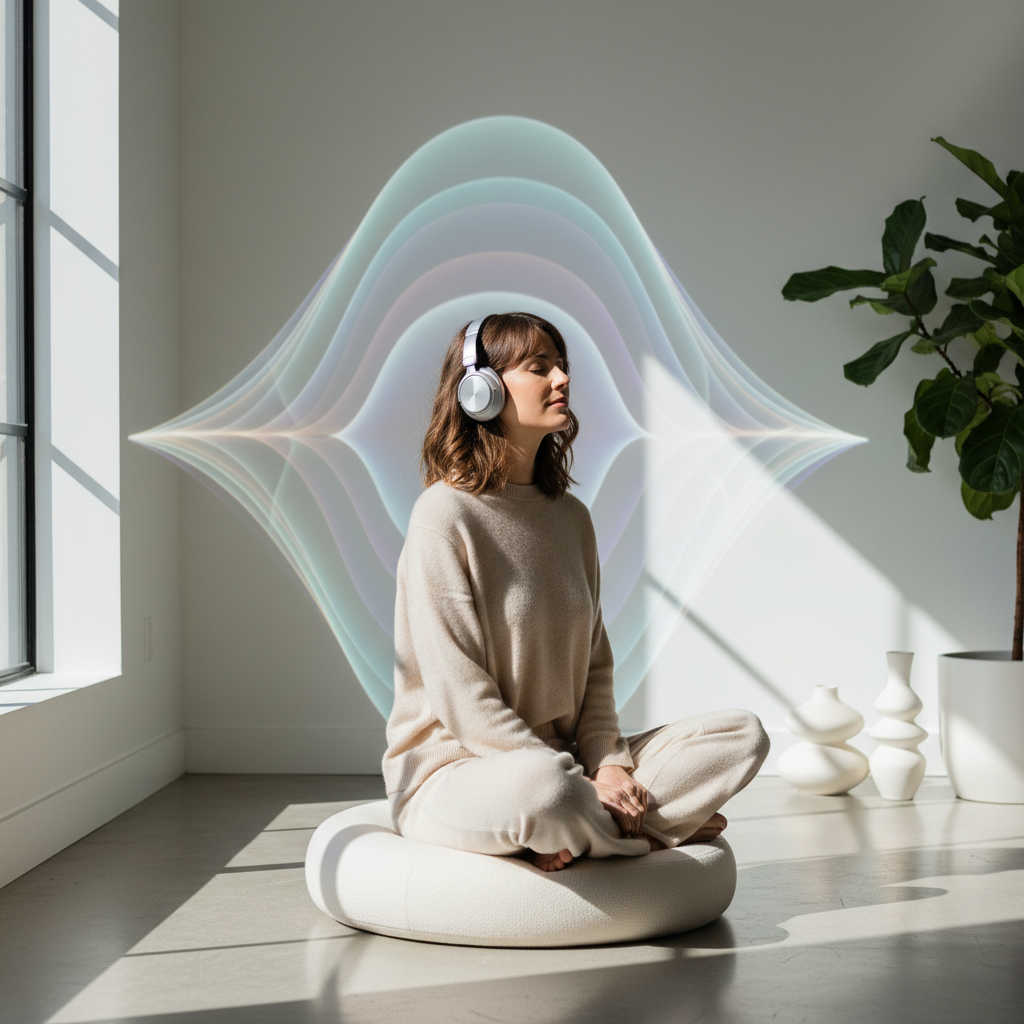
Find a quiet spot and put the headphones on. Choose an alpha-range track (8–14 Hz) for a first attempt, since that range is the most reliably pleasant. Close your eyes and listen for 15 to 20 minutes. What people usually report is a sense of calm arriving somewhere around the 5 to 10 minute mark, a quieting of mental chatter, or a sensation of the sound opening up as they settle into it.
The effect is subtle. It is a shift in mental state rather than a transformation, and anyone promising otherwise is selling something.
Building a routine
Consistency matters more than session length. Most research studies use sessions of 15–30 minutes, and daily listening over 2–4 weeks will tell you far more than one long session ever will. Match the range to the intention: alpha or theta before bed, beta or gamma during work, delta if sleep is the whole point.
Combining with other practices
Binaural beats pair well with meditation and breathwork, mostly because a steady tone gives wandering attention something to return to. Some yoga practitioners run theta tracks during savasana. Students and knowledge workers tend to leave beta or gamma tracks going as background audio while they work.
Best Apps and Tools
Brain.fm (free tier, roughly $50/year) is our top pick. It builds AI-generated music with entrainment patterns embedded in it, binaural beats included, and sorts everything into Focus, Relax and Sleep modes. The interface stays out of the way, and the free tier covers enough sessions to work out whether any of it does anything for you.
Insight Timer (free) is one of the largest meditation apps in the world, with a deep library of binaural tracks sitting alongside guided meditations and ambient music. Good for sampling a lot of frequencies and styles without paying for any of them.
Solfeggio and binaural tracks on YouTube (free) run into the thousands. Production quality is all over the place, so look for channels that label exact frequencies and produce clean audio. Skip anything whose title makes a medical claim.
myNoise.net (free, donation supported) was built by a signal processing PhD and offers binaural generators with precise frequency control. This is the one to use if you would rather set the parameters yourself than trust somebody’s preset.
Binaural beat generator apps ($0 to $10) on iOS and Android let you set the exact frequency going into each ear. Worth having if you want to experiment properly.
→ Our picks: Best Frequency Wellness Devices of 2026
Binaural Beats vs. Other Frequency Technologies
| Factor | Binaural Beats | PEMF | Microcurrent (Healy) |
|---|---|---|---|
| How it works | Sound waves → brain entrainment | EM pulses → cellular stimulation | Electrical current → ATP production |
| Cost to start | Free | $500+ | $506+ |
| Equipment needed | Headphones only | PEMF mat or device | Healy device + smartphone |
| Best for | Relaxation, focus, sleep, meditation | Recovery, comfort, circulation | Portable daily wellness |
| Evidence level | Moderate (growing) | Strong | Moderate |
| Physical risk | Virtually none | Very low (avoid with pacemakers) | Very low (avoid with pacemakers) |
These are not competing technologies. Binaural beats act on brain electrical patterns through sound; PEMF and microcurrent devices act on cellular processes through fields or current. Plenty of people run both, and there is no mechanism by which one would interfere with the other.
→ All types compared: 5 Types of Frequency Technology Explained
Limitations and Honest Caveats
The entrainment effect is inconsistent
Some studies confirm brainwave entrainment and others fail to find it. The 2023 PLOS ONE systematic review counted more negative results than positive ones. That does not settle the question against binaural beats. It may simply mean the effect depends on parameters, individual differences and listening conditions that nobody has standardised yet.
Subjective effects may partly reflect placebo
Sit quietly with headphones on, eyes closed, having already decided to relax, and you have built most of the conditions for relaxing before a single tone plays. Whatever is in the audio is only part of what is acting on you. Separating the beat from the ritual around it is genuinely difficult, and most studies struggle with exactly this.
Individual responses vary widely
Some people respond strongly from the first session. Others notice nothing after weeks. Nobody can predict which group you fall into, so the only way to find out is to try it.
Not a replacement for medical treatment
The anxiety and sleep research is promising, but binaural beats should not replace professional treatment for clinical anxiety disorders, insomnia, depression or any other medical condition. They are a wellness tool, not a therapy.
Headphones are mandatory
The effect only exists when stereo headphones deliver a different frequency to each ear. Speakers, bone-conduction headphones and mono earbuds will not produce a binaural beat.
Key Takeaways
- Binaural beats are an auditory illusion created when two slightly different frequencies are played to each ear, producing a perceived third tone at the difference frequency.
- The brainwave entrainment hypothesis proposes that listening encourages the brain’s electrical activity to synchronise with the beat frequency. Research has confirmed this in some conditions and failed to find it in others.
- Five brainwave ranges correspond to different mental states: delta (sleep), theta (meditation), alpha (relaxation), beta (focus) and gamma (peak cognition).
- Anxiety reduction has the strongest research support, with a 2024 systematic review finding binaural beats outperformed control conditions across most studies reviewed.
- Binaural beats are the most accessible frequency technology there is. They cost nothing, need only headphones, and carry virtually no physical risk.
- The evidence is promising but inconsistent, varying by study design, frequency parameters and the individual listening.
- Start with alpha-range tracks (8–14 Hz) for 15–20 minutes daily over 2–4 weeks to judge your own response.
Frequently Asked Questions
Are binaural beats safe?
Yes. Binaural beats are only sound, and they carry virtually no physical risk for most people. Two groups should be careful. Anyone with epilepsy or a seizure disorder should speak to a doctor first, since rhythmic auditory stimulation could in theory affect seizure thresholds. Anyone with sound sensitivity or tinnitus should start at low volume with short sessions.
How long should I listen to binaural beats?
Most research uses sessions of 15–30 minutes. Start at 15 and extend if it feels comfortable. Some people run 45–60 minute sessions for sleep or deep meditation, though nothing in the evidence suggests longer sessions produce proportionally stronger effects.
Can I listen to binaural beats while working?
Yes. Beta and gamma range tracks (14–50 Hz) are made for focus and concentration, and plenty of people use them as study or work background audio. Brain.fm’s “Focus” mode exists for precisely this.
Do binaural beats work without headphones?
No. Each ear has to receive a different frequency at the same time. Speakers blend the two tones in the air, which eliminates the binaural effect. Stereo headphones are essential.
What’s the difference between binaural beats and isochronal tones?
A binaural beat is created by two slightly different frequencies, one per ear, and the rhythm exists only inside your brain. An isochronal tone is a single tone pulsing on and off at the target frequency, so the rhythm is really there in the sound. That means isochronal tones work through speakers and need no headphones, but they have been studied far less than binaural beats.
Can binaural beats replace meditation?
No. They are a tool that can support meditation rather than a substitute for it. Meditation builds attention, awareness and emotional regulation through repeated practice. Binaural beats can make certain mental states easier to reach, but the benefits of meditation come from doing the practice.
References
- Baseanu, I.C.C. et al. (2024). “The Efficiency of Binaural Beats on Anxiety and Depression — A Systematic Review.” Applied Sciences, 14(13), 5675. Read the full study →
- Basu, S. & Banerjee, B. (2023). “Potential of binaural beats intervention for improving memory and attention.” Psychological Research, 87(4), 951–963. Read the full study →
- Ingendoh, R.M. et al. (2023). “Binaural beats to entrain the brain? A systematic review of the effects of binaural beat stimulation on brain oscillatory activity.” PLOS ONE. Read the full study →
- Melnichuk, A. et al. (2025). “A parametric investigation of binaural beats for brain entrainment and enhancing sustained attention.” Scientific Reports, 15, 4308. Read the full study →
- Platt, J. & Hammond, L. (2025). “Is non-clinical, personal use of binaural beats audio an effective stress-management strategy? A systematic review of randomised control trials.” Advances in Mental Health, 23(2), 258–286. Read the full study →
Continue Reading on Frequency Tech
- Frequency Technology Explained: A Beginner’s Guide (2026)
- 5 Types of Frequency Technology Explained
- The Science Behind Frequency Technology
- Best Frequency Wellness Devices of 2026
- How to Choose a Frequency Device
- Frequency Technology Glossary
Disclaimer: The information on Frequency Tech is for educational and informational purposes only. Binaural beats are not intended to diagnose, treat, cure, or prevent any disease. The content on this site does not constitute medical advice. Always consult a qualified healthcare professional for clinical anxiety, insomnia, or other medical conditions. Some links on this site may be affiliate links, and you can see our full disclosure policy for details.
The complete neuroacoustic learning path
Explore specific tools and platforms: