
What Is PEMF? A Complete Guide to Pulsed Electromagnetic Field
Quick answer
PEMF (pulsed electromagnetic field) therapy sends brief, low-frequency electromagnetic pulses through the body to support cellular energy, calm inflammation and aid tissue repair. It has the strongest evidence base of any consumer frequency technology, including FDA approval for bone healing since 1979; benefits for comfort, sleep and mood are promising but less proven. It is very safe for most adults but not for people with pacemakers or during pregnancy, and regular daily use matters more than high intensity.
If you’ve been exploring frequency wellness devices, you’ve almost certainly come across the term PEMF. It shows up in product descriptions, wellness forums, and biohacking communities, often with bold claims attached. But what actually is PEMF therapy, and why does it have more published research behind it than any other consumer frequency technology?
This guide gives you the full picture: how PEMF works at the cellular level, what the research says, what devices are available, and how to decide if it’s the right technology for your wellness goals.
Table of Contents
- What Is PEMF?
- How PEMF Works at the Cellular Level
- A Brief History of PEMF Technology
- What the Research Says
- Types of PEMF Devices
- What a PEMF Session Feels Like
- Who Uses PEMF?
- Safety and Contraindications
- How to Choose a PEMF Device
- Key Takeaways
- Frequently Asked Questions
What Is PEMF?
PEMF stands for Pulsed Electromagnetic Field. It’s a technology that generates brief, low-frequency electromagnetic pulses that pass through the body’s tissues. Unlike a static magnet (like a refrigerator magnet, which produces a constant field), PEMF devices create electromagnetic fields that pulse on and off at specific frequencies and intensities.
The concept is simple at its core: the human body is fundamentally electrical. Your cells maintain electrical charges across their membranes. Your nervous system transmits information through electrical signals. Your heart generates an electromagnetic field strong enough to be measured several feet away. PEMF technology works by introducing external electromagnetic pulses that interact with the body’s own electrical systems at the cellular level.
What makes PEMF notable in the frequency wellness space is its evidence base. While many frequency technologies rely primarily on anecdotal reports, PEMF has accumulated a substantial body of peer-reviewed research — including FDA approval dating back to 1979 for specific applications.
How PEMF Works at the Cellular Level
PEMF makes the most sense once you know what’s happening at the cellular level.
Every cell in your body maintains an electrical charge — a voltage difference across its membrane called the membrane potential. In a healthy, well-functioning cell, this potential typically sits around -70 to -90 millivolts. When cells are stressed, injured, or functioning sub-optimally, this voltage drops.
PEMF works by introducing electromagnetic pulses that interact with this cellular electrical system. According to a peer-reviewed paper in JAAOS Global Research & Reviews (Cadossi et al., 2020), the primary mechanism involves PEMF interacting with adenosine receptors (specifically A2A and A3 receptors) on cell membranes. This interaction triggers a cascade of cellular responses including increased production of ATP (the cell’s primary energy currency), stimulation of structural and signaling molecules in the extracellular matrix, anti-inflammatory effects through modulation of cytokine levels, and enhanced synthesis of components needed for tissue repair.
Think of it this way: if your cells are batteries, PEMF is like a charger. It doesn’t heal anything directly — it supports the conditions that allow your body’s own repair and maintenance systems to function more efficiently.
The electromagnetic pulses used in PEMF are extremely low energy. They’re far below the frequencies and intensities used in medical imaging (like MRI) or radiation. Most consumer PEMF devices operate between 1 and 50 Hz (pulses per second) at intensities measured in microtesla — a tiny fraction of the Earth’s natural magnetic field.
Key PEMF parameters
Understanding these terms helps when comparing devices:
Frequency (Hz) — how many pulses per second. Research suggests the 1–50 Hz range is most relevant for wellness applications. The Earth’s own magnetic field resonates at approximately 7.83 Hz (the Schumann resonance), and many PEMF protocols operate near this range.
Intensity (Gauss or Tesla) — the strength of the electromagnetic field. Consumer devices typically range from 0.5 to 100 Gauss. Low-intensity devices (under 1 Gauss) are used for general wellness; higher-intensity devices are used for targeted applications. Learn how PEMF intensity is measured in gauss and tesla.
Waveform — the shape of each electromagnetic pulse. Common waveforms include sine wave, square wave, and sawtooth. Different waveforms deliver energy differently — sawtooth waves, for example, contain a broader spectrum of frequencies within each pulse.
Duration — session length. Most protocols recommend 8–30 minutes per session, one to two times daily.
A Brief History of PEMF Technology
PEMF isn’t new. The idea that electromagnetic fields influence biological processes has been explored since the 19th century, but the modern era of PEMF begins in the mid-20th century.
In the 1950s and 1960s, researchers began investigating the electrical properties of bone tissue. Japanese scientist Yasuda demonstrated that mechanical stress on bone generates electrical signals — a phenomenon called piezoelectricity. This discovery laid the groundwork for using external electromagnetic fields to support bone recovery.
In 1979, the U.S. Food and Drug Administration approved PEMF devices for the management of non-union bone fractures — fractures that had failed to mend on their own. This was a landmark moment: an electromagnetic frequency technology with official regulatory backing based on clinical trial data.
Through the 1980s and 1990s, PEMF research expanded into soft tissue applications. Studies explored its effects on wound recovery, inflammation, pain management, and circulation. European countries, particularly Germany, Austria, and Switzerland, adopted PEMF more broadly than the United States, with devices becoming common in clinical rehabilitation settings.
The 2000s saw the emergence of consumer-grade PEMF devices. Companies like BEMER (founded in 1998), iMRS, and later HealthyLine brought PEMF technology from clinical settings into homes. Today, the global PEMF device market is valued at over $600 million and growing at approximately 11% annually, driven by increasing interest in non-invasive wellness technologies.
→ Related reading: Frequency Technology Explained: A Beginner’s Guide
What the Research Says
PEMF has the most extensive research base of any consumer frequency technology. Here’s how the evidence breaks down.
Strong evidence: Bone recovery
This is PEMF’s most established application. A 2020 review in JAAOS Global Research & Reviews (Cadossi et al.) reported that “considerable level 1 evidence has accumulated, demonstrating clinical efficacy of PEMF exposure in accelerating healing of fresh fractures and osteotomies,” with reported success rates for non-union fractures ranging from 73% to 85%. The FDA considers PEMF safe and effective for this application, and the same survey found that 72% of US hospitals offer bone repair stimulation for fractures that fail to heal. A separate 2021 review in the International Journal of Molecular Sciences (Caliogna et al.) reached similar conclusions on the adenosine-receptor mechanism.
Moderate evidence: Comfort and inflammation
Multiple studies have examined PEMF for joint comfort, particularly in conditions like osteoarthritis. The research generally shows positive results — reduced discomfort and improved function — but studies vary widely in PEMF parameters, duration, and outcome measures, making it difficult to establish definitive protocols. Younger patients and those with early-stage conditions tend to show stronger responses.
PEMF’s anti-inflammatory effects have a plausible mechanism: research shows that PEMF modulates cytokine levels, reducing pro-inflammatory markers while supporting anti-inflammatory ones. This has been demonstrated in both laboratory and clinical settings.
Emerging evidence: Sleep, mood, and circulation
Smaller studies have explored PEMF for sleep improvement, mood support, and microcirculation enhancement. The BEMER device in particular has published research on its effects on microcirculation. These studies are generally positive but limited in size and scope. Sleep and mood applications are areas of active research interest, but the evidence isn’t yet strong enough to make confident claims.
What the evidence doesn’t support
Despite some enthusiastic marketing claims, PEMF has not been proven to reverse specific diseases, replace medication or medical intervention, produce dramatically different results based on “proprietary” signal patterns versus standard PEMF parameters, or work through mechanisms that contradict established physics.
→ Deep dive: The Science Behind Frequency Technology: What Research Actually Shows
Types of PEMF Devices
Consumer PEMF devices come in several form factors, each suited to different use cases.
Full-body mats
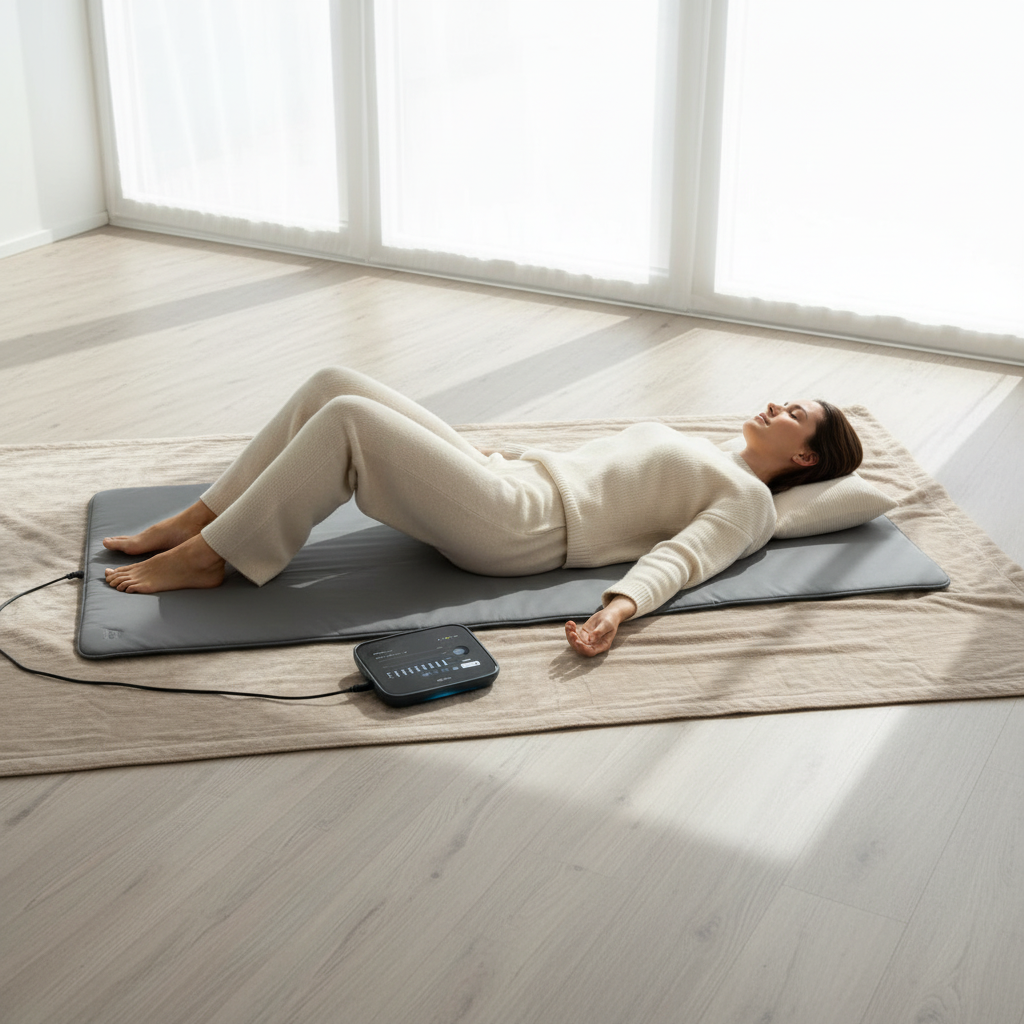
These are the most common consumer PEMF format. You lie on the PEMF mat for your session, and the embedded coils deliver electromagnetic pulses across your entire body. Sessions typically last 8–30 minutes. Mats range from basic models with limited frequency options to advanced systems with multiple waveforms, adjustable intensity, and programmable protocols.
Notable examples include the HealthyLine Platinum series (combining PEMF with far infrared and crystals), the BEMER Evo (focused on microcirculation), and the iMRS Prime (emphasizing programmable customization).
Localized applicators
Pad-style or coil-style applicators target specific areas of the body — a knee, shoulder, lower back, or neck. Many full-body mat systems include localized applicators as accessories. These are useful when you want to focus PEMF on a particular area rather than delivering it to the whole body.
Portable devices
Smaller, battery-powered PEMF devices like the FlexPulse and EarthPulse are designed for portability. They typically have lower intensity than mat systems but can be worn or placed on the body throughout the day. These are good options for people who want PEMF on the go or who want to use it during sleep.
Clinical-grade systems
Professional PEMF devices used in clinical settings typically offer higher intensities and more precise parameter control than consumer devices. These are operated by practitioners in rehabilitation clinics, sports medicine facilities, and wellness centers. Prices often exceed $10,000 and aren’t designed for home use.
→ Related reading: Best Frequency Wellness Devices of 2026: A Buyer’s Guide
What a PEMF Session Feels Like
So what does a PEMF session actually feel like? It’s the question people ask most.
Most people feel very little during a PEMF session, especially with low-intensity devices. You might notice a subtle warmth, a gentle tingling or pulsing sensation near the coils, a feeling of deep relaxation (particularly with lower frequencies), or nothing at all during the session.
The absence of sensation doesn’t mean nothing is happening. PEMF operates at the cellular level — below the threshold of conscious perception for most people. Many users report that the effects become apparent after the session rather than during it: improved sleep quality that night, reduced morning stiffness, a general sense of improved energy, or faster recovery after physical activity.
Higher-intensity PEMF devices produce a more noticeable sensation — a definite pulsing or tapping feeling as the electromagnetic field activates. This is normal and not harmful, but it can be startling if you’re not expecting it.
For best results, most PEMF practitioners recommend consistency over intensity. Regular daily sessions (even at low intensity) tend to produce more noticeable benefits than occasional intense sessions.
Who Uses PEMF?
PEMF has attracted a diverse user base.
Athletes and fitness enthusiasts use PEMF for post-workout recovery, muscle soreness reduction, and performance support. Several professional sports teams and Olympic athletes have incorporated PEMF into their recovery protocols.
Wellness and biohacking communities use PEMF as part of broader optimization routines, often combining it with red light, cold exposure, and other modalities.
People managing ongoing discomfort use PEMF for joint and muscle comfort support, particularly those looking for non-invasive, non-pharmaceutical options.
Sleep-focused users use low-frequency PEMF (particularly in the 1–10 Hz range) to support sleep quality and relaxation.
Older adults represent a growing PEMF user group, particularly for bone health support and general vitality.
Safety and Contraindications
PEMF has a strong safety profile when used as directed. The electromagnetic fields generated by consumer devices are extremely low energy — far below the levels used in MRI machines, which are considered safe even for repeated use.
That said, certain groups should avoid PEMF or consult a medical professional first. People with pacemakers or other implanted electronic devices should not use PEMF — the electromagnetic pulses could potentially interfere with device function. Pregnant women are generally advised to avoid PEMF due to a lack of safety data for this population. People with epilepsy should consult their doctor, as electromagnetic stimulation could theoretically affect seizure thresholds. Anyone with an active implant (cochlear implant, insulin pump, etc.) should check with their device manufacturer and physician.
For everyone else, PEMF is generally considered very safe. No serious adverse events have been reported in the published literature for consumer-grade devices used as directed. Some people experience mild, temporary effects like headache, dizziness, or fatigue after their first few sessions — these typically resolve quickly and may be related to the body adjusting to the stimulation.
→ Related reading: Are Frequency Devices Safe? Everything You Need to Know
How to Choose a PEMF Device
With dozens of PEMF devices on the market ranging from $200 to $20,000+, choosing the right one depends on your goals, budget, and how you plan to use it.
For general wellness and daily use
A full-body mat in the $500–$2,000 range offers the best value. Look for adjustable frequency (at least 1–30 Hz), adjustable intensity, and a reputable manufacturer with a reasonable return policy. The HealthyLine Platinum series is our top pick in this category.
For targeted comfort support
Consider a device with localized applicators in addition to (or instead of) a full-body mat. Targeted pads let you focus PEMF on specific areas where you need support most.
For portability
Portable devices like the FlexPulse are the best option if you want to use PEMF on the go or during sleep. They sacrifice intensity for convenience but still deliver meaningful electromagnetic stimulation.
For maximum research-backed credibility
The BEMER Evo has more device-specific published studies than most competitors, though it comes at a premium price ($5,000+) and its frequency options are more limited than other devices in its price range.
Key questions to ask before buying
What frequency range does the device offer? Look for at least 1–30 Hz. What waveform options are available? More options give you more flexibility. What is the return policy? A 30-day trial period is ideal for a device in this price range. Is the company transparent about their specifications? Vague specs are a red flag. Does the price reflect the technology, or is it inflated by an MLM distribution model?
→ Our picks: Best Frequency Wellness Devices of 2026: A Buyer’s Guide
Key Takeaways
- PEMF (Pulsed Electromagnetic Field) technology delivers brief electromagnetic pulses that interact with the body’s cells to support natural recovery and maintenance processes.
- PEMF has the strongest evidence base of any consumer frequency technology, with FDA approval for bone recovery dating to 1979.
- The primary mechanism involves interaction with adenosine receptors on cell membranes, triggering increased ATP production, anti-inflammatory effects, and enhanced tissue repair signaling.
- Bone recovery has the strongest evidence. Comfort, inflammation, sleep, and mood support show promising but preliminary results.
- Consumer PEMF devices come in full-body mats, localized applicators, and portable units — choose based on your goals and lifestyle.
- PEMF is generally very safe but should be avoided by people with pacemakers, during pregnancy, and potentially with epilepsy.
- Consistency matters more than intensity — regular daily sessions produce better results than occasional high-intensity use.
Frequently Asked Questions
Is PEMF the same as a TENS unit?
No. PEMF and TENS are both electromagnetic technologies, but they work differently. TENS delivers electrical currents directly through the skin via electrode pads, primarily targeting nerve stimulation for pain management. PEMF delivers electromagnetic pulses through coils that don’t require skin contact — the pulses pass through tissue to influence cellular processes more broadly. PEMF has a wider range of researched applications beyond pain management.
How often should I use a PEMF device?
Most manufacturers and practitioners recommend 1–2 sessions per day, each lasting 8–30 minutes. Consistency is more important than session length. Many users find that building PEMF into a daily routine — morning or evening — produces the most noticeable results over 2–4 weeks.
Can I feel PEMF working?
Most people feel very little during low-intensity PEMF sessions — perhaps subtle warmth or a gentle pulsing. Higher-intensity devices produce a more noticeable sensation. The effects of PEMF are typically noticed after sessions (improved sleep, reduced stiffness, better recovery) rather than during them.
How long before I notice results from PEMF?
This varies by individual and application. Some users report subjective improvements after a few sessions. For most people, 2–4 weeks of consistent daily use provides a clearer picture of whether PEMF is supporting their wellness goals. Published research on bone recovery involves treatment periods of weeks to months.
Is PEMF FDA approved?
PEMF devices were first FDA premarket-approved (PMA) in 1979 for non-union fractures, and are FDA-cleared or approved for specific applications — primarily bone recovery in non-union fractures, spinal fusion, and supporting circulation in healthy muscles. “Cleared” and “approved” have different meanings at the FDA. Most consumer PEMF devices marketed for general wellness have not been specifically evaluated by the FDA for those broader claims.
What’s the difference between low-intensity and high-intensity PEMF?
Low-intensity PEMF (under 1 Gauss) is what most consumer devices deliver. It’s designed for daily wellness use and is very safe. High-intensity PEMF (100+ Gauss) is used in clinical settings for more targeted applications and requires practitioner supervision. For home use and general wellness, low-intensity PEMF is appropriate and well-researched.
References
- Cadossi, R., Massari, L., Racine-Avila, J., & Aaron, R.K. (2020). “Pulsed Electromagnetic Field Stimulation of Bone Healing and Joint Preservation: Cellular Mechanisms of Skeletal Response.” JAAOS Global Research & Reviews, 4(5). Read the full study →
- Caliogna, L. et al. (2021). “Pulsed Electromagnetic Fields in Bone Healing: Molecular Pathways and Clinical Applications.” International Journal of Molecular Sciences, 22(14). Read the full study →
- U.S. Food and Drug Administration (2020). “Bone Growth Stimulators — Executive Summary.” Read the FDA document →
- Peng, L. et al. (2020). “Effectiveness of Pulsed Electromagnetic Fields on Bone Healing: A Systematic Review and Meta-Analysis of Randomized Controlled Trials.” Bioelectromagnetics, 41(5), 323–337. Read the full study →
- Waldorff, E.I., Zhang, N., & Ryaby, J.T. (2017). “Pulsed electromagnetic field applications: A corporate perspective.” Journal of Orthopaedic Translation, 9, 60–68. Read the full study →
Continue Reading on Frequency Tech
- Frequency Technology Explained: A Beginner’s Guide (2026)
- 5 Types of Frequency Technology Explained
- The Science Behind Frequency Technology: What Research Actually Shows
- Best Frequency Wellness Devices of 2026: A Buyer’s Guide
- What Is Microcurrent? How It Works and What to Expect
Disclaimer: The information on Frequency Tech is for educational and informational purposes only. Frequency wellness devices are not intended to diagnose, treat, cure, or prevent any disease. The content on this site does not constitute medical advice. Always consult a qualified healthcare professional before beginning any new wellness practice, especially if you have existing medical conditions. Some links on this site may be affiliate links — see our full disclosure policy for details.
The complete PEMF learning path
Explore the rest of our PEMF coverage: