
BEMER Review 2026: Is the Premium PEMF System Worth It?
This review is research-based. Here is how we test and score devices.
Quick answer
BEMER is the most established name in PEMF, with a larger device-specific research portfolio than most rivals (much of it industry-funded), excellent build quality and the simplest daily routine, but it costs $4,590 to $5,490 through an MLM model, offers only two frequencies and its signal has not changed since 2007. Consider it if you already know PEMF helps you and want a set-and-forget premium system; skip it if you are new to PEMF or want customization, since comparable PEMF costs 40 to 60 percent less.
BEMER is the biggest name in PEMF. Founded in 1998, it has sold electromagnetic field devices longer than almost anyone, and in many wellness circles its name is synonymous with PEMF therapy. Athletes, biohackers, and clinicians around the world use BEMER systems, and the brand has more device-specific published studies than most competitors.
But BEMER is also one of the most expensive consumer PEMF devices on the market, distributed through an MLM model that inflates pricing, and its technology hasn’t fundamentally changed since 2007. Is the brand reputation justified, or are you paying a premium for marketing and distribution overhead?
This is our independent assessment — what BEMER does well, where it falls short, and whether the price tag makes sense in a market that now has serious competition.
Table of Contents
- What Is BEMER?
- BEMER Editions and Pricing
- How BEMER Works: The Patented Signal
- Real-World Experience
- Scoring Breakdown
- What the Research Says
- BEMER vs. Alternatives
- Pros and Cons
- Final Verdict
- Frequently Asked Questions
Quick Verdict
Score: 3.9 / 5.0
Best for: Dedicated wellness enthusiasts who’ve confirmed PEMF works for them and want a premium system with a larger brand-specific research base than most competitors (much of it industry-funded).
Not for: First-time buyers, budget-conscious shoppers, or anyone who needs frequency customization beyond two settings.
What Is BEMER?
BEMER stands for Bio-Electro-Magnetic-Energy-Regulation. The company was founded in 1998 in Austria and is now headquartered in Liechtenstein. BEMER produces PEMF (Pulsed Electromagnetic Field) devices focused specifically on supporting microcirculation — the flow of blood through the body’s smallest blood vessels (capillaries, arterioles, and venules).
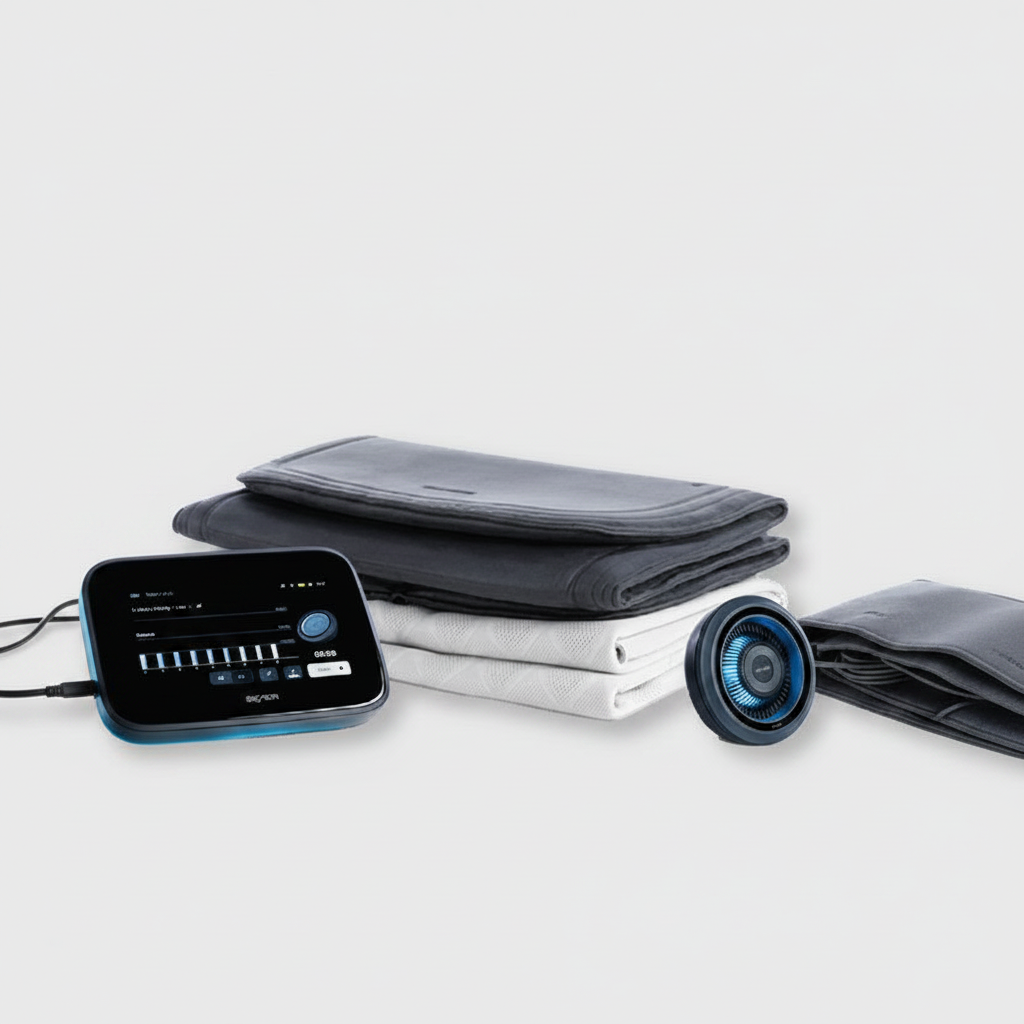
The BEMER system consists of a control unit (the B.Box Evo), a full-body mat applicator (B.Body Evo), and optional targeted applicators for specific body areas. The device delivers BEMER’s patented electromagnetic signal through the mat while you lie on it, with standard sessions lasting just 8 minutes, recommended twice daily.
BEMER holds an FDA Class II 510(k) clearance (K231368) as a powered muscle stimulator — specifically to temporarily increase local blood circulation in healthy leg muscles and to stimulate healthy muscles to improve and facilitate muscle performance. This clearance does not cover treating any disease or condition. The company cites a large body of published research associated with its signal technology — more than most consumer PEMF brands — though much of it is BEMER-affiliated or industry-funded (see the research section below). It’s used by professional athletes, clinics, and an active global user base.
Like the Healy, BEMER is distributed through an Independent BEMER Distributor (IBD) network — an MLM structure. That matters: it inflates the price and skews the reviews you’ll find online.
BEMER Editions and Pricing
BEMER’s current product line is the Evo series. In the US market, the editions have been renamed from the previous Pro/Classic naming convention.
| Edition | Includes | Price (USD) |
|---|---|---|
| Basic-Set Evo | B.Box Evo controller + B.Body Evo mat | ~$4,590 |
| Classic-Set Evo | B.Box + B.Body + B.Pad + B.Spot applicators | ~$5,490 |
| Premium-Set Evo | B.Box + B.Body + B.Bed + B.Pad + B.Spot + accessories | ~$5,490 |
Important pricing context: These are list prices from BEMER’s official US shop (Basic-Set Evo $4,590; Classic-Set and Premium-Set Evo $5,490). BEMER distributors occasionally offer promotional pricing, and used BEMER Pro-Set units can be found on eBay for $2,000–$3,000 (though without manufacturer warranty). Be aware that the new Evo line is NOT compatible with previous Pro/Classic line applicators — if you buy used, make sure the entire system matches.
Optional add-ons include the B.Light Beauty Pack Evo (red light applicator, ~$1,000+) and a battery stand for cordless operation.
At roughly $4,590–$5,490, BEMER is among the most expensive consumer PEMF systems on the market — a fact that demands scrutiny.
How BEMER Works: The Patented Signal
BEMER’s central differentiator is its patented electromagnetic signal. Rather than offering adjustable frequency settings (like many PEMF competitors), BEMER delivers a single proprietary waveform designed specifically for what the company calls “Physical Vascular Therapy.”
The BEMER signal operates primarily at two frequencies: 10 Hz and 33 Hz (with a 10 Hz sleep mode). The signal pattern is described as a series of half-wave-shaped, sine-like intensity variations that repeat about 33 times per second, with roughly 1,200 total pulses per second. For the full-body mat, the magnetic flux density spans from about 3.5 to 35 microtesla (0.035 to 0.35 Gauss) across 10 intensity levels — a low intensity by PEMF standards.
The theory is that this specific signal pattern is uniquely effective at supporting vasomotion — the rhythmic contraction and relaxation of the body’s smallest blood vessels that drives microcirculation. BEMER’s marketing positions this as a key advantage over competitors that use generic PEMF signals.
What this means in practice
The patented-signal approach cuts both ways. On the positive side, BEMER has invested significantly in researching their specific signal, giving them more device-specific studies than competitors. Sessions are simple and fast — you don’t need to choose frequencies, waveforms, or intensities (beyond the 1–10 level). The signal is consistent and well-defined.
On the other hand, the limited frequency range (only 10 Hz and 33 Hz) means you can’t explore frequencies in the 1–8 Hz range (commonly associated with sleep and deep relaxation) or higher frequencies. You’re locked into BEMER’s proprietary approach with no customization. And the relatively low intensity (0.035–0.35 Gauss) is at the bottom end of what consumer PEMF devices typically offer — some critics argue it’s underpowered compared to the 10–20 Gauss range that some PEMF pain studies have used.
Real-World Experience
Setup
BEMER setup is straightforward. Place the B.Body mat on a flat surface (bed, sofa, or floor), connect it to the B.Box controller via the magnetic plug, plug in, and you’re ready. The interface is simple — select an intensity level (1–10) and start. No app required, no software to learn, no programs to choose between.
This simplicity is genuinely refreshing compared to devices like the Healy, which offers hundreds of programs. BEMER’s approach is: lie down, press a button, wait 8 minutes, done.
Daily use
The recommended protocol is two 8-minute sessions per day — morning and evening. At 16 total minutes daily, BEMER has one of the shortest daily time commitments of any frequency device. Most users report that the sessions fit easily into their routine — lying on the mat while drinking morning coffee or winding down before bed.
During a session, most users feel little to nothing. Some report a subtle warmth or gentle tingling, particularly at higher intensity levels. The session ends automatically, and the controller beeps.
What users notice
Over 2–4 weeks of consistent use, commonly reported experiences include improved sleep quality (especially when using the sleep mode program before bed), feeling more rested upon waking, reduced post-exercise stiffness, a general sense of improved energy and recovery, and improved circulation in extremities (warmer hands and feet). These reports are consistent across multiple independent review sources, though they remain subjective and haven’t been confirmed through controlled studies comparing BEMER to other PEMF devices.
Scoring Breakdown
| Criterion | Score | Notes |
|---|---|---|
| Ease of Use | 4.5 / 5 | Simplest PEMF experience. Lie down, press button, 8 minutes. No learning curve. |
| Build Quality | 4.5 / 5 | Premium materials and construction. Feels like a professional medical device. |
| Program Depth | 2.0 / 5 | Only 2 frequencies, 1 waveform, 10 intensity levels. The least customizable premium PEMF device. |
| Evidence Base | 4.0 / 5 | Large device-specific research base, more than most competitors — but much of it is BEMER-affiliated or industry-funded. Independent results are mixed, with several finding no significant effect. |
| Value for Money | 2.5 / 5 | At roughly $4,590–$5,490, it’s 2–3x the price of competitors offering more features. MLM markup is significant. |
| Community & Support | 3.5 / 5 | Active distributor network. Customer service has received mixed reviews — some report slow responses. |
| Daily Usability | 5.0 / 5 | 8-minute sessions, twice daily. Easiest protocol of any PEMF device. Almost zero friction. |
Overall: 3.9 / 5.0
What the Research Says
BEMER has more device-specific published research than most consumer PEMF brands — over 50 studies associated with its signal technology. This is a genuine advantage. However, the research picture requires nuance.
What the studies show
The strongest findings relate to microcirculation. BEMER-associated studies have reported increases in capillary blood velocity (one frequently cited figure is around 28%) and potential improvements in circulation, comfort, and recovery parameters. Notably, several of these studies were conducted or funded by parties affiliated with BEMER.
However, independent reviews of BEMER’s research base have noted several limitations. Many studies were conducted by researchers affiliated with or funded by BEMER Group, introducing potential bias. Some studies lacked proper control groups. Sample sizes were often small. Results for applications beyond circulation (pain, performance, recovery) were mixed, with several studies finding non-statistically-significant differences.
One notable independent study of healthy individuals found “a significant increase of all measurement parameters during the study compared to the baseline values with no difference between the PEMF and control group” — meaning the BEMER group didn’t outperform the control. Another study investigating skin microcirculation in feet concluded that BEMER did not enhance circulation in that specific application.
The honest assessment
BEMER’s research portfolio is larger than most competitors’, and the microcirculation focus is supported by some positive findings. However, the research is not as conclusive as BEMER’s marketing suggests, and BEMER should not be described as “clinically proven” or “the most studied” PEMF device without that caveat. Much of the supporting research is industry-affiliated, and when independent researchers have tested the device, results have been mixed — several controlled studies found no significant microcirculation effect versus control. The claim that BEMER’s signal is uniquely superior to other PEMF signals has not been established through head-to-head comparative studies.
→ Related reading: What Is PEMF? A Complete Guide
BEMER vs. Alternatives
| Factor | BEMER Evo | HealthyLine Platinum | Healy Resonance |
|---|---|---|---|
| Technology | PEMF only | PEMF + Far Infrared + Crystal | Microcurrent (IMF) |
| Frequencies | 2 (10 Hz, 33 Hz) | 1–30 Hz (fully adjustable) | Hundreds of programs |
| Waveforms | 1 (proprietary) | 3 (sine, square, sawtooth) | Multiple (app-controlled) |
| Session time | 8 min, 2x daily | 20–40 min | 20–60 min |
| Portability | Low (mat system) | Low (mat system) | High (pocket-sized) |
| Published studies | Large base (much BEMER-funded/affiliated) | Category-level PEMF research | 1 observational study |
| Distribution | MLM (IBD network) | Direct / retail | MLM (distributor network) |
| Price | $4,590–$5,490 | ~$2,000 | ~$1,515 |
The comparison raises a difficult question: is BEMER’s patented signal worth 2–3x the price of competitors that offer more features, more customization, and comparable or broader PEMF evidence? For users who value simplicity, brand heritage, and BEMER’s specific microcirculation focus, the answer may be yes. For users who want versatility, customization, or better value per dollar, alternatives are compelling.
→ Full comparison: Best Frequency Wellness Devices of 2026
Pros and Cons
Pros
- Simplest PEMF experience — 8-minute sessions, no settings to learn
- Large device-specific research base — more studies than most competitors, though much of it is BEMER-affiliated or industry-funded
- Premium build quality — professional-grade materials and construction
- FDA Class II cleared — K231368, to temporarily increase local blood circulation in healthy leg muscles and stimulate healthy muscles
- Established brand — 25+ years in the market, global presence
- Multiple applicators — full-body mat plus targeted spot and pad options
- Quick daily commitment — 16 minutes total per day
Cons
- Extremely expensive — roughly $4,590–$5,490, among the highest in the consumer PEMF market
- Very limited customization — only 2 frequencies, 1 waveform, 10 intensity levels
- MLM distribution — inflates price and compromises review objectivity
- Low intensity range — 0.035–0.35 Gauss is at the bottom of consumer PEMF devices
- Technology unchanged since 2007 — the PEMF signal itself hasn’t evolved
- Evo line incompatible with previous models — can’t upgrade accessory by accessory
- Mixed independent research — some studies found no significant difference versus control
- Customer service complaints — some users report slow response times
Final Verdict
Consider BEMER if you…
Have already confirmed that PEMF technology supports your wellness goals and want the simplest possible daily experience. Value brand heritage, build quality, and a larger device-specific research portfolio than most competitors (with the caveat that much of it is industry-funded). Prioritize microcirculation support specifically. Can comfortably afford the premium price without stretching your budget. Prefer a “set it and forget it” approach over customization.
Skip BEMER if you…
Are new to frequency technology — never spend $4,500+ on your first device. Want frequency customization — BEMER’s 2-frequency limitation is genuinely restrictive compared to alternatives. Are budget-conscious — comparable PEMF experiences are available at 40–60% of BEMER’s price. Want the latest technology — BEMER’s signal hasn’t changed since 2007, while competitors have advanced. Are uncomfortable with MLM-distributed products — the pricing and review landscape are affected.
Our recommended alternative
For most users, the HealthyLine Platinum PEMF Mat (~$2,000) delivers a more versatile PEMF experience at less than half the price. It offers 3 waveforms, adjustable frequency (1–30 Hz), adjustable intensity, plus far infrared and crystal elements. You lose BEMER’s specific signal and device-level research, but you gain significant flexibility and save $2,000–$4,000.
If budget is not a concern and you specifically want the BEMER experience, buy during a promotional period and ensure you understand the return policy (72-hour cancellation on enrollment fee; product return terms vary).
→ Compare all options: How to Choose a Frequency Device: Decision Guide
→ See also: Healy Device Review 2026
Frequently Asked Questions
Is BEMER worth the price?
That depends on what you’re comparing it to. BEMER delivers a genuine PEMF experience with more device-specific research than most consumer brands, though much of it is industry-funded and independent results are mixed. However, at roughly $4,590–$5,490, you’re paying a significant premium — much of which reflects the MLM distribution model and brand positioning rather than technological superiority. Comparable PEMF experiences are available from direct-to-consumer brands at 40–60% of BEMER’s price.
Can I try BEMER before buying?
Some BEMER distributors offer rental programs — contact a local distributor to ask about try-before-you-buy options. This is strongly recommended given the price point. Also check the return policy carefully; BEMER’s standard terms include a 72-hour enrollment fee cancellation, with product return terms that may vary.
How does BEMER compare to the Healy?
They’re fundamentally different devices. BEMER is a full-body PEMF mat focused on microcirculation with a 2×8-minute daily protocol. The Healy is a portable microcurrent device with hundreds of app-driven programs. BEMER excels at simplicity and has more research; the Healy excels at portability and variety. They complement each other rather than compete directly.
Is the BEMER signal really unique?
BEMER’s signal pattern is patented and proprietary. However, independent PEMF reviewers have noted that some competing devices (like the Sedona Pro) can replicate similar signal characteristics, and there are no published head-to-head studies proving BEMER’s signal is more effective than other quality PEMF signals.
Does NASA use BEMER?
BEMER and NASA signed a cooperation agreement in 2018 for research related to future space missions. This is a legitimate relationship, but it should not be interpreted as NASA endorsing BEMER for consumer wellness use. The cooperation is focused on research, not a product endorsement.
Is BEMER an MLM?
Yes. BEMER is distributed through Independent BEMER Distributors (IBDs) using a multi-level marketing structure. Distributors earn commissions on sales and can recruit other distributors. This affects pricing (MLM overhead contributes to the premium price) and review objectivity (many online reviews come from people who earn money from sales).
References
- Cadossi, R., Massari, L., Racine-Avila, J., & Aaron, R. K. (2020). “Pulsed Electromagnetic Field Stimulation of Bone Healing and Joint Preservation: Cellular Mechanisms of Skeletal Response.” JAAOS Global Research & Reviews, 4(5). Read the full study →
- Caliogna, L. et al. (2021). “Pulsed Electromagnetic Fields in Bone Healing: Molecular Pathways and Clinical Applications.” International Journal of Molecular Sciences, 22(14). Read the full study →
- U.S. Food and Drug Administration (2020). “Bone Growth Stimulators — Executive Summary.” Read the FDA document →
Continue Reading on Frequency Tech
- What Is PEMF? A Complete Guide
- Healy Device Review 2026
- Best Frequency Wellness Devices of 2026
- How to Choose a Frequency Device
- The Science Behind Frequency Technology
- 5 Types of Frequency Technology Explained
Disclaimer: The information on Frequency Tech is for educational and informational purposes only. Frequency wellness devices are not intended to diagnose, treat, cure, or prevent any disease. The content on this site does not constitute medical advice. Always consult a qualified healthcare professional before beginning any new wellness practice. Frequency Tech is not affiliated with BEMER Group. Some links on this site may be affiliate links — see our full disclosure policy for details.
PEMF silo: continue exploring
BEMER is one of several PEMF devices. For context: